
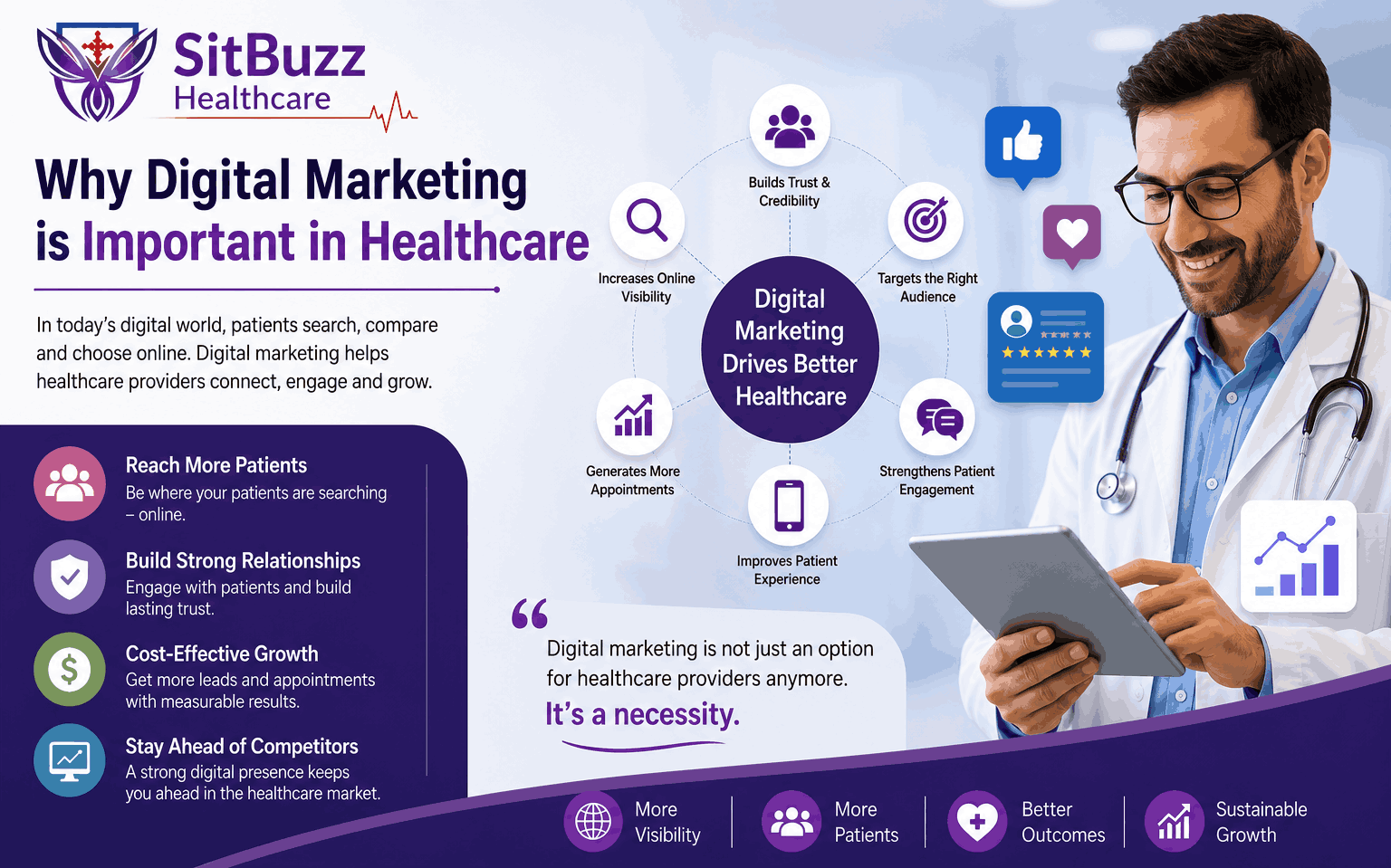
The healthcare industry used to be one of the slowest sectors to change. Today it is one of the most progressive industries, joining other consumer-centric industries in putting the patient first. I have worked with healthcare organizations, small healthcare practice owners, hospitals, and large hospital systems, and the pattern is always the same. The clinics that treat patient care and patient engagement as marketing priorities grow faster than those that don’t. A strong online presence is not a luxury for a healthcare business anymore. It’s how you get found, get trusted, and get booked.
Healthcare consumers, or simply customers, now do online research as their initial research step before choosing a doctor. A recent study from Pew Internet and the American Life Project found that 80% of Internet users and online users look up a health-related topic online, and approximately 93 million Americans search for health information or medical information every year. Around 77% start with a general search, while 9% go straight to online resources built by hospitals themselves. That’s not a small audience to ignore. If your online visibility is weak, patients simply won’t find your medical website services, let alone your online appointment booking page.
This shift ties directly into bigger changes inside the clinic too. Electronic health records (EHR), digital healthcare, and the move from paper medical records to full digitization show how much digital transformation has already reshaped this field. Healthcare technology and healthcare innovation force every healthcare professional to stay agile and keep adapting to rapid change and unpredictable change. This brings real challenges and real opportunities, more data means more value, but also more responsibility around data security. Leveraging cutting edge tools only works when regulations like, HIPAA regulations, and FDA compliance are respected. Healthcare compliance must be monitored closely, and yes, marketing messages stay constrained by law, but that doesn’t mean marketing becomes any less of a priority.
This is exactly why healthcare marketing and medical marketing need their own strategy. Good marketing strategies, real marketing efforts, and honest marketing innovations build healthcare communication that patients actually trust. A clear digital marketing strategy supports promotion, digital promotion, and branding, which together create awareness in a market full of competition. Practices that stay competitive and build a real competitive edge win patient acquisition and keep ongoing care strong, improving care outcomes and giving people an improved patient experience. Add lead generation built around true search intent, the things people have actually searched for, and you get online engagement that converts. Compare this year to 2026, or the way things looked ten years ago; the shift is huge, and it is not slowing down. Practices that invest now in the right tools set themselves up for organizational success and long-term healthcare growth.
What is Healthcare Digital Marketing?
I still remember the past, when healthcare marketing meant traditional tactics, print, TV, radio, direct mail, and marketers would launch campaigns, hope for the best, and stay unable to make real-time adjustments once the ads were published. Today, healthcare digital marketing is a completely different game. In present times, hospitals and clinics focused on acquiring patients face a population that is less proactive, more particular, and quick to reject or delay procedures when cost feels too high, because the healthcare consumer is healthier, lives longer, and relies on health systems far less than general patients once did. That exactly where digital marketing steps in providers now promote their offerings through online platforms and online presence to delight an increasingly online population, using extensive research, access to physician reviews, ratings, and online forums where patients interact over similar conditions.
In my own client work, this must-have investment is not optional anymore, it’s how modern health systems stay connected with current patients and future patients, driving patient engagement, physician engagement, retention, and better in-network utilization. Put simply, healthcare digital marketing is the practice of promoting services through online channels so people who seek health information, which directly influences their treatment decisions, can find you first. A sound digital marketing strategy helps you reach those people and convince them to choose your healthcare services. The common forms I rely on for clients include content marketing, email marketing, pay-per-click advertising, SEO, and social media marketing, layered approaches that improve and improve practice visibility, attract patients, and help them learn more, easily.
Why Digital Marketing Matters in Healthcare
Today environment has changed the rules for hospitals, healthcare organizations, and every healthcare provider I have worked with. The consumer walking through the door, or scrolling on their phone, is remarkably smart, demanding transparency, and expects real two-way communication, not a one-way pamphlet.
Yet I still see healthcare marketers and marketing departments dealing with the same slow habits, clinging to traditional channels like tv, mail, and billboards long after patients stopped considering them useful. Healthcare consumers today are opting for online services because they are faster and simpler, and if your tactics haven’t caught up, you’re already behind the curve.
This is exactly why I tell every healthcare practice I advise to adopt digital marketing without hesitation, it’s no longer optional, it’s a critical role in creating and improving patient experience from the very first search. Innovative teams that stay ahead aren’t guessing, they’re leveraging vast data to give context to every decision, stabilizing a new brand or brands after a merger, and finding unique opportunities other healthcare providers overlook.
The benefit shows up in many ways, better appeal, more convenience, faster speed, and genuine ease for the people you’re trying to reach. My honest advice, based on years of watching budgets get wasted, shift budgets away from outdated reasons for holding back, start investing in what’s available now, and you’ll see exactly why digital isn’t a trend, it’s survival.
Key Benefits of Healthcare Digital Marketing
I have watched small clinics turn into busy practices simply by getting digital marketing right, and here’s the honest truth, it’s one of the most powerful tools a healthcare industry professional has today. When you promote your practice and services online, your name starts to pop up whenever people run searches for the best medical professionals near them, and that visibility alone is enough to attract patients who are ready to use services.
What I love most about solid digital marketing strategies is how they let you target patients by age, sex, location, and interests, real factors that shape a personalized experience for your audience instead of a generic message that reaches no one in particular. That kind of precision is what turns a scattered effort into a successful campaign.
But there’s more to it than just reaching people, you have to solve real problems. In my experience, trust is vital in healthcare, and nothing builds expertise and establishes authority faster than choosing to create online content around the common issues your patients face every day. Create a few honest blog posts or You-tube videos that solve problems for potential customers, and you’ll build stronger relationships that make them far more likely to trust you when it matters most, that’s how you show people you genuinely know your field.
Essential Healthcare Digital Marketing Strategies
After years in healthcare marketing, I can tell you we’re in the midst of a real revolution, and today’s competitive healthcare landscape rewards only practices willing to adapt, which is why I keep coming back to six digital tactics I consider critical for engaging patients properly, applied not as a one-off push but as ongoing work that keeps driving steady growth month after month.
Search Engine Optimization (SEO) for Healthcare
A Think With Google study backs up something I told every client for years, search engines drive three times more visitors to hospital websites than any other sources, and 44% of patients who research hospitals on a mobile device end up scheduling appointments.4 That single stat tells you everything about how consumers behave today, their extensive use of search to find facilities, inquire about health, and make decisions before ever calling a clinic is exactly why healthcare marketers I work with keep search engine optimization, or SEO, front-of-mind when considering their overall digital strategy. Social media has its place in building a provider’s brand and helping to build prospective patients’ trust back toward the provider’s website, but it simply can’t replace what SEO does at scale.
That is why I always tell clinics that medical SEO stays crucial to any successful digital marketing strategy, no exceptions. In my own experience, the practices that win are run by effective marketers who build websites genuinely loaded with the right keywords tied to the provider’s area of expertise, not stuffed, just relevant, a point backed by Medical Economics as well. The result? Their website naturally appears higher in search engine rankings and results pages, which is the whole point of doing this work in the first place.
Video Marketing for Healthcare
I say it plainly video marketing is the next major opportunity to engage consumers in a field as innately personal as healthcare. Few industries carry as much emotional weight, which makes ours a genuinely narrative-rich industry, and video has powerful applications here that plain text just can’t match. I have seen clinics share real patient stories through dynamic storytelling paired with honest visuals, and that visual format does something quiet but important, it helps new site visitors develop a sense of trust in an organization long before making appointments. That’s exactly why I consider video an ideal medium for providing information in healthcare, not just a nice extra.
Beyond the emotional side, video earns its place for a practical reason too, health issues are often complex, and diseases can be hard to explain in writing, but video makes them simple and easy-to-understand almost instantly. I have used it myself to explain post-op steps to worried patients, and to spread important information about community health initiatives across a whole practice at once. It works just as well to walk people through post-surgical recovery procedures step by step, or to educate the public on general wellness in a way that actually sticks, something I’ve watched happen again and again with my own clients.
Personalized Healthcare Marketing Campaigns
Health is a personal subject, and healthcare marketing built on a generic, cookie-cutter approach simply falls flat. Someone seeking medical care for general wellness and someone facing a life-threatening emergency or disease are in completely different headspaces, so your messaging has to be deeply emotional and specific, not one-size-fits-all. I always tell marketers the same thing, if you target the wrong patients, you don’t just waste the budget, you risk failing to reach the right ones who genuinely need you. Understanding your target audience is the first step, and it’s the difference between content and ads that produce advertising noise versus content that actually resonates.
This is where a healthcare CRM, or HCRM, becomes the most important tool on the platform side of things. I have relied on this myself to turn comprehensive patient data and existing healthcare data into real, usable target personas instead of guesswork. From there, you can construct and build campaigns around key demographic information like age, gender, and residence, layered with clinical detail such as diagnosis and prognosis detail, plus propensity models that predict behavior. The result is an ultra-detailed campaign that speaks to the right person, at the right moment, for the right reason.
Email Marketing for Healthcare Providers
I still hear people say email marketing is dead, but in my experience it’s very much still alive, and honestly one of the most low-cost, effective channels available in the healthcare industry today. What makes it stand out is that it’s an immediate form of communication with real room for narrow-focus personalization, so instead of blasting the same message to everyone, you can speak directly to the patient in front of you. Executed correctly, the ROI on an email marketing campaign can be genuinely significant, but there are real considerations healthcare marketers need to weigh before building out an email strategy, and skipping them is where most campaigns quietly fail.
The key one I always flag first, based on years of watching report after report optimizing for mobile delivery isn’t optional anymore. A striking 47.6% of emails in this space get opened on a mobile device, compared to only 25.9% on a desktop computer, a gap too big to ignore. That means for your emails to feel impactful, and honestly just legible, in the mobile interface, responsive design is absolutely critical, an opportunity most practices still leave on the table.
Analytics and Data-Driven Decision Making
One thing I appreciate most about digital marketing is the ability to track performance in real time and make real-time adjustments the moment a campaign stops going as planned, something traditional channels never allowed. This is exactly why I lean so heavily on marketing analytics to guide the decision-making process at every stage, from planning through execution, rather than relying on guesswork. What surprises a lot of clients is how much vast data is available for free through digital marketing analytics platforms, and once you know how to read it, it becomes the clearest way for healthcare organizations to understand who their patients really are and how to better serve their needs.
In my own campaigns, I have used Google AdWords to discover which demographics respond best to a practice’s unique value proposition, giving each organization real clarity on where to focus. Google Analytics, on the other hand, helps me understand exactly what information compels someone to decide to choose a specific healthcare provider over another. And when I want direct input straight from the source, online survey tools or easily deployed options like Google Remarketing let me ask the audience direct questions about their needs and their overall experience, no guessing required.
Enhancing Patient Experience Through Digital Marketing
Something I noticed early in my career still holds true today, when someone has a health issue, they don’t wait around, they go straight to the Internet, treating it as a resource designed to help them find a solution fast. Back in 2012, Google ran a study that fielded over 500 hospital researchers and found that 77% of patients used a search engine prior to booking an appointment with a healthcare provider, relying on online sources for their hospital research far more than most likely anyone expected at the time. That report confirms what I see with almost every client, the patient journey now starts long before they ever call your office.
That is exactly why having a strong website and active social media profiles matters so much, it lets people contact you across multiple platforms the moment they’re ready, not just during business hours. Interacting with your audience on these channels genuinely connects you with potential patients who share similar interests and concerns, making them easily reachable and far more comfortable contacting you when it counts.
HIPAA Compliance in Healthcare Digital Marketing
The Health Insurance Portability and Accountability Act, or HIPAA, is not optional fine print, it’s the law that protects health information and patient health information from being disclosed without proper consent. The Department of Health and Human Services has issued clear guidelines that ban providers from combining personally identifiable information with any particular health condition someone searched for on a website. I have seen agencies like Cardinal Digital Marketing flag this exact issue, marketers simply cannot match an IP address to a health search and then market to the user based on that data, whether online or through any other channel.
This is why I always tell marketers to evaluate their analytics platforms and marketing programs carefully, making sure everything stays HIPAA-compliant and fully compliant, even if that means being willing to forgo collecting certain data altogether. To genuinely understand this regulatory framework and make sound marketing decisions within a real healthcare context, I point any rising professional toward something like ETSU’s Health Care Marketing program, it’s built for professionals who want to operate correctly from day one. Through an MBA like this, marketers learn the exact skills needed to forge genuinely successful careers in a field that will only become more vital over the next decade.
Adapting to the Future of Healthcare Marketing
I have watched the healthcare industry go through real turbulence over the past decade, healthcare policy reform and shifting market factors have driven significant consolidation through wave after wave of mergers and acquisitions, leaving administrators and marketing departments genuinely struggling to maintain patient experience and hold onto a clear brand story for their organization. The old playbook of large, costly, traditional marketing campaigns just doesn’t work anymore in this environment.
What I tell every client instead is that digital campaigns are easy to scale up, and messaging can be changed virtually at any time. A good digital marketing strategy can inform you the moment increasing competition or shifts in your markets appear, letting you push new messages and updates out to patients at a moment’s notice.
Looking ahead, the Internet and every connected device now sit at the nexus of how individuals communicate and interact with the world, and honestly, the future belongs to any team that’s genuinely adept at digital marketing and staying at the cutting edge of new opportunities to connect, advertise, and inform.
I find myself asking the same questions my clients do, will the Internet of Things truly take off and turn personalized data into real customized experiences for patients, or will wearables, Fitbits, voice tools like Alexa, and smart-home systems stay short of becoming true connected data exchange networks, as many experts anticipate?
Even Google’s advanced AI and machine learning research raise the same question, can it really understand what searchers are looking for and return the exact right result? One algorithm already helps doctors spot the risk of a major cardiac event quicker and easier, so it’s not far-fetched to think machines will keep learning to learn exactly what we mean when we search.
Conclusion
Looking back at everything I have covered, one thing stands out clearly from my own years in this field, digital marketing has genuinely helped the healthcare industry evolve, and it has not been one single tactic doing the work, it’s been search engines used as a real tool, targeted outreach built on multi-media content, engaging patients through social media, and campaign data analytics guiding every decision.
From where I sit, the practical side matters just as much, solid digital marketing services, from website development and optimization to SEO, social media marketing, online portal set-up, referral management tools, and personalized ad campaigns, give practices innovative ways of attracting new clients they never reach otherwise. And with real pressures like the diabetes epidemic and nursing shortages creating genuine challenges heading into 2026, I be honest, not everything can be solved through a screen alone.
But any healthcare organization that wants to prioritize patient experience, compete for new markets, and reach more patients simply has to invest in digital, because that’s where the industry, and the people it serves, are already headed.


